- Detachment, Awareness, and Moral Responsibility: Creating the Space for Conscious Choice
- What Do Neuroscience and Modern Philosophy Reveal About Free Will and Consciousness?
- Neural Precursors and Causality: How the Brain Acts Before the Mind Decides
- Is Free Will an Illusion? Exploring the Hypothesis Through Cognitive Science
- Awareness as the Inner Thermostat: Regulating to Balance
- The Sensory–Motor System: Linking Perception, Intention, and Action
- Decision-Making as an Embodied Cognitive Process
- The Prefrontal Cortex: The Neurobiological Seat of Intentionality and Free Will
- From Reaction to Response: The True Expression of Free Will
- How to Reclaim Free Will in a World of Automatic Living
- FAQ
Free Will: Do We Really Have It, or Does Determinism Decide Before We Do?
Have you ever paused and wondered: Did I actually choose that—or did something deeper choose for me? Do we truly have free will, or do we follow a script shaped by causal determinism, the laws of nature, and a world where many argue that determinism is true? What you call “choice” may often be a habit in disguise. In Western philosophy, this classic debate about free will and determinism sits at the intersection of philosophy of mind and ethics: is free action possible, and if so, how can it be compatible with determinism while still preserving moral responsibility?
Key Aspects
- Free will and determinism interact through layers of brain, body, and awareness, rather than as a simple yes-or-no opposition.
- Neural precursors to action suggest that impulses arise before conscious awareness, but they do not rule out a conscious veto or modulation of those impulses.
- The prefrontal cortex supports inhibition, planning, and self-reflection, making it central to any realistic account of conscious choice.
- Embodied processes in the sensory–motor system, the gut–brain axis, and heart–brain communication show that decisions are never purely mental.
- Practices that expand awareness and regulate the nervous system increase your capacity to move from automatic reactions to more deliberate responses.
- When the body shifts out of survival mode, the mind–body connection strengthens, and awareness expands. In this regulated state, conditioned patterns lose their grip, and the Default Mode Network supports reflection rather than rumination.
Detachment, Awareness, and Moral Responsibility: Creating the Space for Conscious Choice
Free will exists, but not in the way most people imagine. Many assume it means total freedom to do whatever one wants, whenever one wants—a kind of libertarian openness. But the mind does not function that way. Much of your human action comes from unconscious patterns, old conditioning, and stories you never consciously chose. When you begin to observe those forces without getting caught in them, you create space. In that space, free choice becomes possible as conscious intention—this is the heart of soft compatibilism, the view that free will is compatible with determinism, even when some argue that free will is incompatible with certain forms of determinism.
Detachment does not make you cold or distant. It gives you room to breathe. It creates separation between your true self and the story you have carried. In that clarity, you realize: “I am not this thought or emotion. I do not have to follow this feeling.” That realization carries moral responsibility, reminding you that even in a deterministic system governed by the laws of nature, awareness allows you to choose the direction of your actions. Some who argue that free will is impossible claim that everything is predetermined; others hold that free agency emerges from the ability to pause. This is where soft determinism and compatibilist models shine: they say free will might exist even if determinism might also be true.
What Do Neuroscience and Modern Philosophy Reveal About Free Will and Consciousness?
Neuroscience maps how decisions form in the brain, while philosophy asks what that formation means for responsibility, agency, and the experience of choosing.
Researchers today no longer treat free will as just a philosophical back-and-forth. Neuroscientists now explore free agency through decades of experiments, and many of those studies show something striking: a large part of our behavior starts before we’re consciously aware of it. Hard determinists and psychological determinists often use this to argue that free will doesn’t exist—or at least that our choices don’t come from an independent, autonomous source.
But not everyone agrees. Others believe that awareness steps in at key moments in ways that strict determinism can’t fully explain, leaving room for genuine human intention.
For clear, approachable summaries, people often turn to the Stanford Encyclopedia of Philosophy or university philosophy departments—not because these sources resolve debates, but because they help map the landscape. They outline everything from libertarian views and theological or biological determinism to logical determinism, soft determinism, compatibilism, and the long-standing puzzle of free will vs. determinism. These frameworks explore all sides: that free will might be impossible, that it can’t survive if determinism is true, or that some form of free agency remains—even in a universe where every event unfolds according to underlying laws.
Neural Precursors and Causality: How the Brain Acts Before the Mind Decides
Neural activity often precedes your awareness of choosing, but this timing gap does not automatically erase your role in shaping what happens next.
Benjamin Libet’s landmark 1983 experiment sparked the modern free-will debate. He asked participants to flex a finger at random while researchers recorded brain activity using an EEG. Libet discovered a signal called the readiness potential (RP) that appeared 300–500 milliseconds before participants reported deciding to move. In other words, the brain began preparing for action first, and consciousness arrived afterward with the story: “I chose this.” This raised the problem of free agency under causality—especially for those who believe in free will and those who do not accept free conscious initiation.
Decades later, Chun Siong Soon and colleagues (2008) extended this timeline. Using fMRI, they tracked activity in prefrontal and parietal cortices and could predict a participant’s decision up to seven seconds before conscious awareness. Such findings are often cited by determinist thinkers who hold that determinism eliminates autonomous origination, as well as by philosophers who argue that free will is an illusion. Yet the data also motivate a model of free agency in which consciousness continues to shape action—a form of intentional modulation rather than pure spontaneity.
This evidence forces us to ask: if the brain moves first, do we truly choose—or do we only notice choices already set in motion by deterministic processes and then assume there is no such thing as free initiation? Or is there still a window in which awareness influences outcomes, preserving free will and moral responsibility?
Is Free Will an Illusion? Exploring the Hypothesis Through Cognitive Science
Some models treat free will as a narrative overlay on unconscious processes, yet this narrative still shapes how you act, relate, and take responsibility.
Findings from neuroscience and philosophy suggest that what we call free will may be more of an epiphenomenon than an independent force. A convincing narrative overlays unconscious processes, making us feel like authors of decisions we did not initiate—an issue central to the analysis of free agency. Some even say free will is an illusion, arguing that consciousness merely watches decisions unfold.
Michael Gazzaniga’s split-brain work shows how the hemispheres construct reality. When the right hemisphere saw a face, and the left read the word “WRITE,” the patient acted from divided inputs; the left hemisphere then confabulated an explanation. The mind protects a coherent concept of free agency even when causation is opaque. These studies are often taken as evidence for hard determinism, though others insist they do not settle the deeper question of whether free will exists.
Libet’s follow-up nuance matters: although initiation may begin outside awareness, he proposed a conscious veto—arguing that humans retain the ability to cancel impulses. On this reading, free will might manifest as veto power even when determinism structures behavior. Some say this remains necessary for free agency to exist at all; others say veto power is still compatible with determinism.
It is also worth noting how beliefs influence behavior: when disbelief in free will increases, people often show less effort and more excuse-making; conversely, a stable belief in free will can support responsibility and pro-social behavior. These findings highlight the significance of free will in society, regardless of whether determinism is true, and show how the belief in free choice influences behavior, even though determinism can also describe brain processes.
Steps in the Decision-Making Process and Neural Correlates of Free Will
1. Sensory Input
- Automatic: sense organs deliver raw data (sight, sound, touch, etc.).
- No free will here — it’s just a matter of information flow.
2. Perception
- Automatic and shaped by conditioning: the brain interprets input through memory, bias, and expectation.
- Minimal free will — this step runs quickly and mostly unconsciously.
3. Evaluation
- The prefrontal cortex engages, weighing pros and cons, risks and rewards.
- Free will begins to emerge: awareness can slow things down and question impulses.
4. Integration
- The brain integrates past experiences, emotional context (amygdala/limbic system), and current goals.
- Free will strengthens when awareness notices: “Am I acting from habit, fear, or real intention?”
5. Choice
- The brain selects the option that appears most advantageous, influenced by dopamine, habits, and survival patterns.
- Free will is fully realized when awareness and the prefrontal cortex intervene, creating a space between impulse and action.
Awareness as the Inner Thermostat: Regulating to Balance
Awareness regulates how far impulses translate into action, turning raw determinism into something you can work with rather than be ruled by.
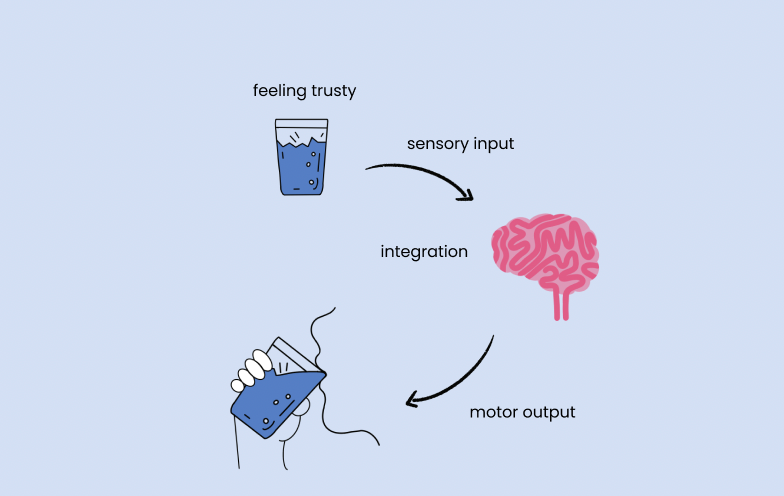
Neuroscientific findings about neural precursors to action are striking, yet they never tell the whole story. Humans do not exist as “brains that decide” in isolation. You live as an embodied being with a nervous system that constantly regulates the balance between the inner and outer worlds. Think of awareness as an inner thermostat that holds you within a window where reason, intention, and moral responsibility can operate. Without that regulation, human free agency narrows, and automatic behavior dominates, creating the sense that you do not have conscious, free steering. In such moments, free will seems threatened, and some claim it becomes incompatible with free intentionality.
The sensory–motor system and the faculty of interoception together illustrate that free will never reduces to thought alone. Free will must integrate perception, emotion, and bodily awareness. Free will depends on the body’s ability to generate awareness, regulate responses, and sustain alignment between perception, feeling, and action. The inner thermostat makes choice possible by creating balance, which in turn strengthens the basis for free agency.
The Sensory–Motor System: Linking Perception, Intention, and Action
The sensory–motor system shows that choice is always embodied; your brain cannot decide in a vacuum without signals from the body and environment.
The system bridges perception and movement. It gathers signals, routes them via sensory pathways to the somatosensory cortex, and returns motor commands from the motor cortex to muscles via motor neurons. The cerebellum refines coordination and timing for voluntary actions—from walking on uneven ground to writing sentences. This closed-loop design supports free action by enabling responsive movement; without it, an agent is free only in theory, a point many determinist thinkers use to argue that free will is not possible under strict determinism.
Sensory receptors gather crucial information:
- Photoreceptors in the eyes detect light, enabling vision.
- Mechanoreceptors in the skin and joints sense touch, pressure, and body position.
- Thermoreceptors register changes in temperature.
- Nociceptors detect pain signals.
- Chemoreceptors in the nose and on the taste buds detect smell and taste.
Sensory pathways carry gathered information through the spinal cord and brainstem to the somatosensory cortex, where the brain processes and interprets it. The motor cortex initiates voluntary movement. From that initiation, motor neurons carry commands from the central nervous system to the muscles, where contraction and relaxation generate action.
The cerebellum fine-tunes movement by coordinating voluntary actions, maintaining balance, and refining motor skills, ensuring that motion unfolds with precision.
The sensory–motor network never confines itself to reflexive behavior alone. It continually integrates sensory feedback with motor commands, allowing you to adapt, refine, and sustain complex voluntary behaviors such as walking across uneven ground, speaking fluently, writing sentences, or typing words on a screen. This interplay demonstrates why some argue that free will requires bodily alignment, while others insist that deterministic neural pathways show the illusion of free agency.
Decision-Making as an Embodied Cognitive Process
Decisions emerge from a dialogue among brain, gut, and heart, showing that free will is embodied, relational, and context-dependent rather than purely abstract.
Dr. Gabor Maté emphasizes that decision-making does not occur solely in the brain. Instead, it emerges from an embodied network that links the brain, gut, and heart. This integrated approach directly challenges both the belief that free will is unbounded and the claim that it is impossible under deterministic pressure. The embodied model reframes free will as dynamic and relational rather than mechanical.
- The brain gathers sensory input, compares it with memory, and models possible outcomes.
- The gut generates intuitive signals and communicates through the gut–brain axis.
- The heart transmits emotional and physiological states that influence judgment.
Together, these systems form what cognitive science calls embodied cognition: the mind does not act as a detached calculator but as an integrated expression of body–brain–environment dynamics. Thinking and choosing always happen in a lived body, not just in abstract reasoning. This understanding is deeply relevant to debates about free will because it shows how agency operates within constraints.
The Prefrontal Cortex: The Neurobiological Seat of Intentionality and Free Will
The prefrontal cortex supports inhibition, planning, and self-awareness, making it a key neural substrate for any realistic model of intentional free action.
The PFC —dorsolateral, ventromedial, and anterior cingulate regions—interconnects with the amygdala, basal ganglia, hippocampus, and insula. The PFC matures later than most brain regions. Synaptic pruning, myelination, and growth of inter-regional white matter tracts continue into the mid twenties or even early thirties. This development supports improved planning, conflict monitoring, working memory, ethical reasoning, and self-reflective awareness—capacities required for free choice and for remaining responsible for actions.
When the PFC is compromised, impulsivity increases, and self-regulatory ability diminishes, which strengthens deterministic interpretations of free will as an illusion or as impossible under certain conditions.
Core Neural Operations Behind Conscious Choice
Executive control involves inhibiting impulses, suppressing automatic responses, and delaying gratification.
Working memory holds multiple possibilities in mind and simulates future outcomes.
Conflict monitoring and error detection help regulate responses.
Value-based decision making weighs risk, reward, and moral or social values.
Self-reflective awareness develops metacognition—the ability to observe your thought processes.
These functions contribute to one model of free will for some, while others see them as neural processes fully governed by the laws of nature, reinforcing tensions between free will and determinism.
The Prefrontal Cortex as the Neurobiological Seat of Intentionality
Modern theories in neuroscience and philosophy describe free will as a capacity rather than a constant state. That capacity depends on state, development, and context. When your PFC functions effectively, you can intervene intentionally—even when determinism suggests your impulses have already begun forming. This is the space where some philosophers and neuroscientists say free will might operate despite deterministic forces, defending a form of free agency that does not violate physics but works within it.
From Reaction to Response: The True Expression of Free Will
Freedom does not erase impulses; it reshapes your relationship to them, turning reflexive reaction into considered response.
We love to think we live free. We say that we choose our actions, our words, and our thoughts. Yet honest reflection reveals repetition, not choice. Sources say, “The mind already exists in the body. A person truly becomes the sum of personal habits.” That insight lands deeply. If habits define you, where does freedom live? Some forms of hard determinism and biological determinism insist there is no such thing as free origination at all. Others defend that the existence of free will depends on how awareness intervenes.
Freedom and determinism meet in the “space” Viktor Frankl described between stimulus and response. In that space lives your power to choose. Freedom does not lie in the origin of your impulses. Freedom lies in your relationship to those impulses. When your prefrontal cortex remains online, you can regulate your internal state. Because of that, many philosophers say free will might emerge even though determinism governs neural beginnings.
Your brain may move first. With awareness, emotional regulation, and developed self-control, you can still change the outcome. That form of free will stands as the strongest one we hold. You do not rely on unconditioned spontaneity. You rely on earned ability to override conditioning. This subtle capacity is how compatibilists define free agency, even when determinists sometimes confuse determinism with fatalism by assuming outcomes cannot be altered.
How to Reclaim Free Will in a World of Automatic Living
Reclaiming free will means expanding awareness, training the nervous system, and consciously reshaping the habits that once ran your life on autopilot.
1 — Recognize and Transcend the Illusion of Choice
As we noted earlier, research shows that 90 to 95 percent of daily behavior runs automatically. Habits, reactions, and routines take the lead. The brain seeks efficiency, so the basal ganglia drive behavior on autopilot while the prefrontal cortex conserves energy for higher-level tasks. This is why some philosophers say free will does not exist in its unconditioned form. Yet others insist that awareness is necessary for free agency to emerge, despite deterministic undercurrents.
That is why you need to track the path your habits take. When a reaction rises, observe what thought follows. Notice which story that thought touches. See which emotion it triggers, and watch how that emotion pushes you toward a specific behavior. By observing that full chain—reaction, thought, story, emotion, behavior—you begin to reclaim awareness and create space for choice. This directly challenges the illusion of free choice narrative.
The Brain as Storyteller
Even when actions do not arise from conscious choice, the brain supplies an explanation. The mind creates a narrative: “I did that because.” That narrative does not equal choice. That narrative equals confabulation. The brain seeks unity, logic, and control. Freedom does not live in that illusion. This observation is central to many theories of free will that try to define free agency without assuming metaphysical exemption from the laws of nature.
You then take a different stance: you stop living as a passive participant in your own story and instead become the observer. Some traditions describe this as stepping out of karmic conditioning. Compatibilist philosophers, however, describe it as building an account of free action that does not violate physical laws.
Spinoza captured the pivot: “The highest activity a human being can attain is learning for understanding, because to understand is to be free.” Even though he leaned toward a strict kind of determinism, he believed understanding restores agency.
2 — Create Inner Space Through Awareness and Mindfulness
Choice does not emerge from more complex thinking. Choice emerges from space. You create space to see, to feel, and to avoid reflexive action. Real work begins here. Real shifts follow.
Confront the Dirty Water:
You do not transform by fighting old patterns. You transform by seeing them clearly. The mind resembles a glass filled with dirty water. You want clarity. First, you need to see what is in the glass. You acknowledge, “I see impurity. I see captivity.” Then you pour in clean water. You add insight, presence, and stillness. First, you see. This parallels the idea of free will as awareness rather than origin.
Take the Lion’s Stance:
You face two options when a thought or emotion rises. You can chase it like a dog that chases a stick. Or you can turn like a lion and face the one who threw it. That metaphor carries power. Thoughts distract you only when you chase them. When you face them, they lose control over you. Choice begins there.
Slow the Monkey Mind:
The mind jumps, spirals, and loops. You slow down, even for one breath, and turbulence begins to settle. Stillness reconnects you with your actual self. You meet the one who sees, not the one who reacts. From that seeing, you respond.
3 — Apply Epoché and Suspend Judgment to Discover Truth
If you want freedom to choose, then you step outside your story. That step rarely feels easy, as the mind constantly spins judgments, labels, and explanations. Epoche offers support. Epoche comes from Edmund Husserl, the founder of phenomenology. In simple terms, Epoche means bracketing. You set aside assumptions, judgments, and preconceptions to see things as they are, not as conditioning claims them to be.
Epoché does not deny reality, nor does it permanently erase beliefs. It also does not demand emptiness or passivity. Instead, it invites a temporary suspension: a conscious pause where you say, “I will hold off on judgment for a moment so I can see clearly.”
Why Epoche Matters for Free Will
You bracket judgment, and you touch raw experience. You meet sensations in the body, such as tightness in the chest, heat in the face, or the presence of silence. Then you see what drives you underneath. You may uncover fear, longing, a need for support, or a simple technical problem that says nothing about who you are.
Most people rarely meet life as it is; they filter it through layers of interpretation—about themselves, about others, about what should or should not happen. Epoché interrupts that cycle. It allows you to step outside the automatic storytelling—not forever, but long enough for truth to emerge. With practice, you break free from the old narrative, stop recycling familiar patterns, and step into the power of genuine choice.
Husserl positioned Epoché (The Phenomenological Reduction) as a gateway to pure perception. You encounter phenomena without the distortion of inherited concepts. When you apply Epoché to free will, you create inner space. You stop reacting to labels and choose clarity instead.
Today, I often compare this process to mind mapping. The aim is not to classify or categorize, but rather to peel back layers—like peeling the skin of an onion—placing each assumption or story in brackets until you reach the essence inside, the pure ground of awareness we call the core self.
How Does Epoché Work?
Scenario: Your computer crashes while working on an important project.
- Identify Preconceptions
- Mind reacts automatically:
- “I always mess things up.”
- “This is so unfair.”
- Mind reacts automatically:
- Suspend Judgments
- Put these thoughts in brackets.
- Stop labeling it as failure or injustice.
- Pause instead of explaining the story to yourself.
- Focus on the Experience
- Notice what is happening directly:
- Tightness in the chest.
- Heat in the face.
- Rapid thoughts.
- Let the sensations be without fighting them.
- Notice what is happening directly:
- Discover the Essence
- Underneath the story, you find the real driver:
- Fear of imperfection.
- Need for control and validation.
- Underneath the story, you find the real driver:
4 — Move From Striving to Alignment: The End of Duality
End of duality is by stepping away from judgments and seeing how the story you cling to drives automatic reactions; you create a space. From that space, you can connect more naturally with your true self. You cannot force this connection; as we noted earlier, it emerges on its own when you rest in that openness. If the mind follows story-driven thoughts, it tends to drift into the past or the future. The body, however, always lives in the present. When the mind pulls elsewhere, a mismatch arises. That mismatch is what we call restlessness. Why returning to the present through the mind–body connection becomes essential. When you live from that alignment, freedom stops being a theory and turns into a direct experience.
The End of Duality
Most people live in a state of split: “me versus the world.” You see yourself as separate, as if life is an opponent you must resist, fight, or conquer. That is striving. But when you drop the judgment, the labels, and the comparisons, a shift happens.
- You stop resisting reality.
- You begin moving with reality.
- You stop fighting the current.
- You start to dance with it.
The Mind–Body Connection as the Key to Free Will
You can’t really separate the mind from the body in everyday life. Your awareness lives through your body, not outside of it. When you train your breath and practice being present, you strengthen the prefrontal circuits that steady your intentions and help you pause before you react. That pause is what lets you respond rather than run on autopilot.
If you tune out your body, you stay trapped in reactivity. If you listen to it and care for it, you build resilience, a sense of inner space, and a deeper kind of freedom. This doesn’t solve the big metaphysical question—free will is still one of philosophy’s great mysteries—but it does give you more real, moment-to-moment agency in how you live.
For practical steps to cultivate this alignment, explore the Mind Body Act. It blends scientific insight with lived practice. It shows how reconnecting with the body can unlock freedom in everyday life.
A Flexible Nervous System and Embodied Cognition
Free will requires more than thought. Free will requires a body that enables choice. If your nervous system stays stuck in survival mode—fight, flight, or freeze—you cannot choose. You react. Your body hijacks the moment.
But when your nervous system grows strong and flexible, you can hold the intensity of life without breaking. Anger can arise without exploding. Fear can appear without shutting down. Sadness can move through without drowning in it. That capacity—the strength to remain present with what happens without collapsing—forms the biological foundation of freedom. Every choice stands firmly on that ground.
Embodying Flow, Awareness, and Conscious Agency
Freedom does not exist as an abstract mental idea. Freedom lives in your body. When your mind and body are in harmony, you don’t need to overanalyze. You feel your way through life. Intuition guides you. Presence carries you.
Every time you move beyond an old reaction, every time you interrupt conditioning, you open a door into something new. That opening is flow. That is transformation in motion. That is freedom lived—not in theory but in breath, body, and being.
Your actual actions express your Dharma—your inner truth—not your Karma—your conditioning. Transformation does not occur in one single breakthrough. Unfolds every time you pause, every time you observe, every time you choose again.
That is how habits shift, a new perspective forms, and a new reality takes shape. In that unfolding, freedom reveals itself.