
Freedom of Choice: Do We Really Have Authentic Autonomy?
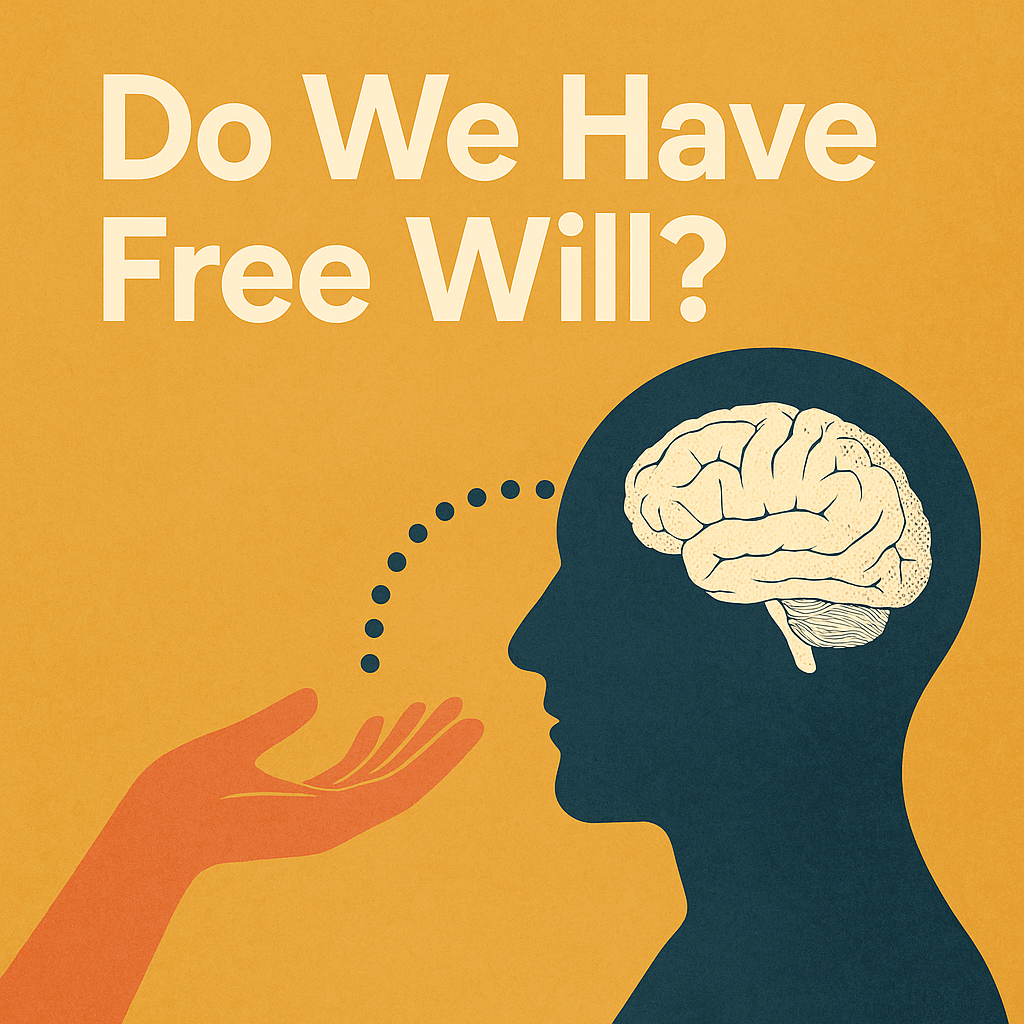
Freedom of choice refers to the human capacity to form intentions, evaluate possible actions, and respond deliberately rather than purely automatically. In a world governed by causal processes, freedom of choice does not necessarily mean complete independence from causes. Instead, it describes the ability to notice impulses, reflect on them, and guide behavior through awareness and self-regulation.
Key Aspects
- Neuroscience reveals the timing paradox: Brain activity (readiness potential) begins 300-500 milliseconds before conscious awareness of deciding, with some studies showing prediction up to 7 seconds in advance.
- Freedom may exist as regulation rather than origination: While we may not consciously initiate impulses, we retain the capacity to inhibit, modify, or redirect them before they become actions.
- The prefrontal cortex enables authentic autonomy: Executive control, working memory, conflict monitoring, and self-reflective awareness create the neurobiological foundation for deliberate choice.
- Beliefs about free will influence behavior: People who believe they have agency exhibit stronger self-control and ethical conduct, whereas disbelief in free will often leads to reduced effort and a diminished sense of responsibility.
- Freedom emerges in the space between stimulus and response: Authentic autonomy lies not in controlling impulses but in developing awareness and the capacity to choose how to relate to those impulses.
- Most daily behavior runs on autopilot: 90-95% of actions are habitual and automatic, making conscious awareness and mindful observation essential for reclaiming genuine choice.
Have you ever paused and wondered: Did I actually choose that, or did something deeper choose for me? This core question drives the debate: do we truly have authentic autonomy, or is our sense of freedom merely shaped by underlying causal determinism and habits? In Western philosophy, this classic debate centers on whether free action is possible, and, if so, how it can be compatible with determinism while still preserving moral responsibility
What Neuroscience Shows About Decision-Making
Philosophers and neuroscientists debate whether genuine autonomy can exist in a determined universe. If every event follows from prior causes, are our choices truly ours, or mere outcomes of biological and psychological processes? This central question requires examining how the brain, body, and awareness interact during decision-making—the crux for claims about authentic autonomy. To explore it, researchers examine whether conscious intention actually initiates action or if neural processes begin preparing behavior before awareness appears.
Benjamin Libet’s landmark 1983 experiment sparked the modern free-will debate. He asked participants to flex a finger at random while researchers recorded brain activity using an EEG. Libet discovered a signal called the readiness potential (RP) that appeared 300–500 milliseconds before participants reported deciding to move. In other words, the brain began preparing for action first, and consciousness arrived afterward with the story: “I chose this.” This raised the problem of free agency under causality—especially for those who believe in free will and those who do not accept free conscious initiation.
Decades later, Chun Siong Soon and colleagues (2008) extended this timeline. Using fMRI, they tracked activity in the prefrontal and parietal cortices and predicted a participant’s decision up to 7 seconds before conscious awareness. Such findings are often cited by determinist thinkers who hold that determinism eliminates autonomous origination, as well as by philosophers who argue that free will is an illusion. Yet the data also motivate a model of free agency in which consciousness continues to shape action—a form of intentional modulation rather than pure spontaneity.
This evidence forces us to ask: if the brain moves first, do we truly choose—or do we only notice choices already set in motion by deterministic processes and then assume there is no such thing as free initiation? Or is there still a window in which awareness influences outcomes, preserving freedom of choice and moral responsibility?
Is Freedom of Choice an Illusion? Exploring the Hypothesis Through Cognitive Science
Some models treat freedom of choice as a narrative overlay on unconscious processes, yet this narrative still shapes how you act, relate, and take responsibility.
Findings from neuroscience and philosophy suggest that what we call freedom of choice may be more of an epiphenomenon than an independent force. This means our core experience of autonomy might be an interpretive overlay on unconscious processes—a key concern when assessing if freedom of choice is authentic or illusory. Some even argue it is an illusion, with consciousness merely watching decisions unfold.
Michael Gazzaniga’s split-brain work shows how the hemispheres construct reality. When the right hemisphere saw a face and the left read the word “WRITE,” the patient acted on divided inputs; the left hemisphere then confabulatory explained. The mind protects a coherent concept of free agency even when causation is opaque. These studies are often taken as evidence for hard determinism, though others insist they do not settle the deeper question of whether it exists.
This debate becomes even more nuanced when considering Benjamin Libet’s later interpretation of his own findings. Although neural initiation may begin outside conscious awareness, Libet proposed a “conscious veto.” According to this view, people may not initiate impulses consciously, but they can still inhibit or cancel them before they turn into action. In this sense, free will may appear not as the origin of impulses but as the capacity to regulate them.
The broader implications extend beyond laboratory experiments. Research suggests that beliefs about free will can influence behavior itself. When people are encouraged to believe that free will does not exist, they often show reduced effort, weaker self-control, and a greater tendency to justify unethical behavior. Conversely, believing that one has some degree of agency tends to strengthen responsibility and pro-social conduct. These findings highlight an important point: regardless of whether determinism ultimately proves true, the way humans understand freedom of choice can shape how they act in the world.
The Prefrontal Cortex: The Neurobiological Seat of Authentic Autonomy
The prefrontal cortex (PFC)—including the dorsolateral, ventromedial, and anterior cingulate regions—forms networks with the amygdala, basal ganglia, hippocampus, and insula. Unlike many other brain areas, the PFC continues developing for a longer period. Processes such as synaptic pruning, myelination, and the strengthening of white-matter connections between regions often extend into the mid-twenties and sometimes into the early thirties.
As these neural systems mature, abilities such as long-term planning, conflict regulation, working memory, ethical evaluation, and self-reflection become more refined. These capacities are essential for deliberate decision-making and for taking responsibility for one’s actions.
Contemporary perspectives in neuroscience and philosophy, therefore, treat freedom of choice not as a constant condition but as a potential that can be expressed to different degrees. Its expression depends on factors such as neural development, mental state, and situational context. When the prefrontal networks operate efficiently, individuals gain the ability to pause, evaluate impulses, and guide behavior intentionally—even if underlying neural processes have already initiated certain tendencies.
Core Neural Operations Behind Conscious Choice
- Executive control helps inhibit impulses, suppress automatic responses, and delay gratification.
- Working memory holds multiple possibilities in mind and simulates future outcomes.
- Conflict monitoring and error detection help regulate responses.
- Value-based decision-making weighs risk, reward, and moral or social values.
- Self-reflective awareness supports metacognition—the ability to observe your own thought processes.
From Reaction to Response: The True Expression of Authentic Autonomy
Freedom does not erase impulses; it reshapes your relationship to them, turning reflexive reaction into considered response.
We like to think we choose our actions, words, and thoughts. Honest reflection, however, reveals repetition rather than real choice—habits shape who we are. Hard and biological determinists argue that freedom of origination is impossible, while others defend authentic autonomy, grounded in the power of awareness to intervene.
Freedom and determinism meet in the “space” Viktor Frankl described between stimulus and response. In that space lives your power to choose. Freedom does not lie in the origin of your impulses. Freedom lies in your relationship to those impulses. When your prefrontal cortex remains online, you can regulate your internal state. Because of that, many philosophers say IY might emerge even though determinism governs neural beginnings.
Your brain may move first. With awareness, emotional regulation, and developed self-control, you can still change the outcome. That form of freedom of choice is the strongest we hold. You do not rely on unconditioned spontaneity. You rely on earned ability to override conditioning. This subtle capacity is how compatibilists define free agency, even though determinists sometimes conflate determinism with fatalism by assuming that outcomes cannot be altered.
How to Reclaim Authentic Autonomy in a World of Automatic Living
1 — Recognize and Transcend the Illusion of Choice
As we noted earlier, research shows that 90 to 95 percent of daily behavior runs automatically. Habits, reactions, and routines take the lead. The brain seeks efficiency, so the basal ganglia drive behavior on autopilot while the prefrontal cortex conserves energy for higher-level tasks. This is why some philosophers say freedom of choice does not exist in its unconditioned form. Yet others insist that awareness is necessary for free agency to emerge, despite deterministic undercurrents.
That is why you need to track the path your habits take. When a reaction rises, observe what thought follows. Notice which story that thought touches. See which emotion it triggers, and watch how that emotion pushes you toward a specific behavior. By observing that full chain—reaction, thought, story, emotion, behavior—you begin to reclaim awareness and create space for choice. This directly challenges the illusion of free choice narrative.
The Brain as Storyteller
Even when actions do not arise from conscious choice, the brain supplies an explanation. The mind creates a narrative: “I did that because.” That narrative does not equal choice. That narrative equals confabulation. The brain seeks unity, logic, and control. Freedom does not live in that illusion.
You then take a different stance: you stop living as a passive participant in your own story and instead become the observer. Some traditions describe this as stepping out of karmic conditioning. Compatibilist philosophers, however, describe it as building an account of free action that does not violate physical laws.
Spinoza captured the pivot: “The highest activity a human being can attain is learning for understanding, because to understand is to be free.” Even though he leaned toward a strict kind of determinism, he believed understanding restores agency.
2 — Create Inner Space Through Awareness and Mindfulness
Choice does not emerge from more complex thinking. Choice emerges from space. You create space to see, to feel, and to avoid reflexive action. Real work begins here. Real shifts follow.
Confront the Dirty Water:
You do not transform by fighting old patterns. You transform by seeing them clearly. The mind resembles a glass filled with dirty water. You want clarity. First, you need to see what is in the glass. You acknowledge, “I see impurity. I see captivity.” Then you pour in clean water. You add insight, presence, and stillness. First, you see. This parallels the idea of authentic autonomy as awareness rather than origin.
Take the Lion’s Stance:
You face two options when a thought or emotion rises. You can chase it like a dog that chases a stick. Or you can turn like a lion and face the one who threw it. That metaphor carries power. Thoughts distract you only when you chase them. When you face them, they lose control over you. Choice begins there.
Slow the Monkey Mind:
The mind jumps, spirals, and loops. You slow down, even for one breath, and turbulence begins to settle. Stillness reconnects you with your actual self. You meet the one who sees, not the one who reacts. From that seeing, you respond.
3 — Step Outside of Your Narrative by Epoché
If you want freedom to choose, then you step outside your story. That step rarely feels easy, as the mind constantly spins judgments, labels, and explanations. Epoche offers support. Epoche comes from Edmund Husserl, the founder of phenomenology. In simple terms, Epoche means bracketing. You set aside assumptions, judgments, and preconceptions to see things as they are, not as conditioning claims them to be.
Husserl positioned Epoché (The Phenomenological Reduction) as a gateway to pure perception. You encounter phenomena without the distortion of inherited concepts. When you apply Epoché to freedom of choice, you create inner space. You stop reacting to labels and choose clarity instead. Epoché does not deny reality, nor does it permanently erase beliefs. It also does not demand emptiness or passivity. Instead, it invites a temporary suspension: a conscious pause where you say, “I will hold off on judgment for a moment so I can see clearly.”
Today, I often compare this process to mind mapping. The aim is not to classify or categorize, but rather to peel back layers—like peeling an onion’s skin—placing each assumption or story in brackets until you reach the essence within, the pure ground of awareness we call the core self. If you are curious about how to practice Epoché step by step in everyday situations, you can explore a practical example later in this article.